Beyond T-Shirts: Live Customization on Hats and Denim Jackets
The pieces guests actually keep are rarely t-shirts. Here is how to run hats and denim live, with honest throughput numbers.
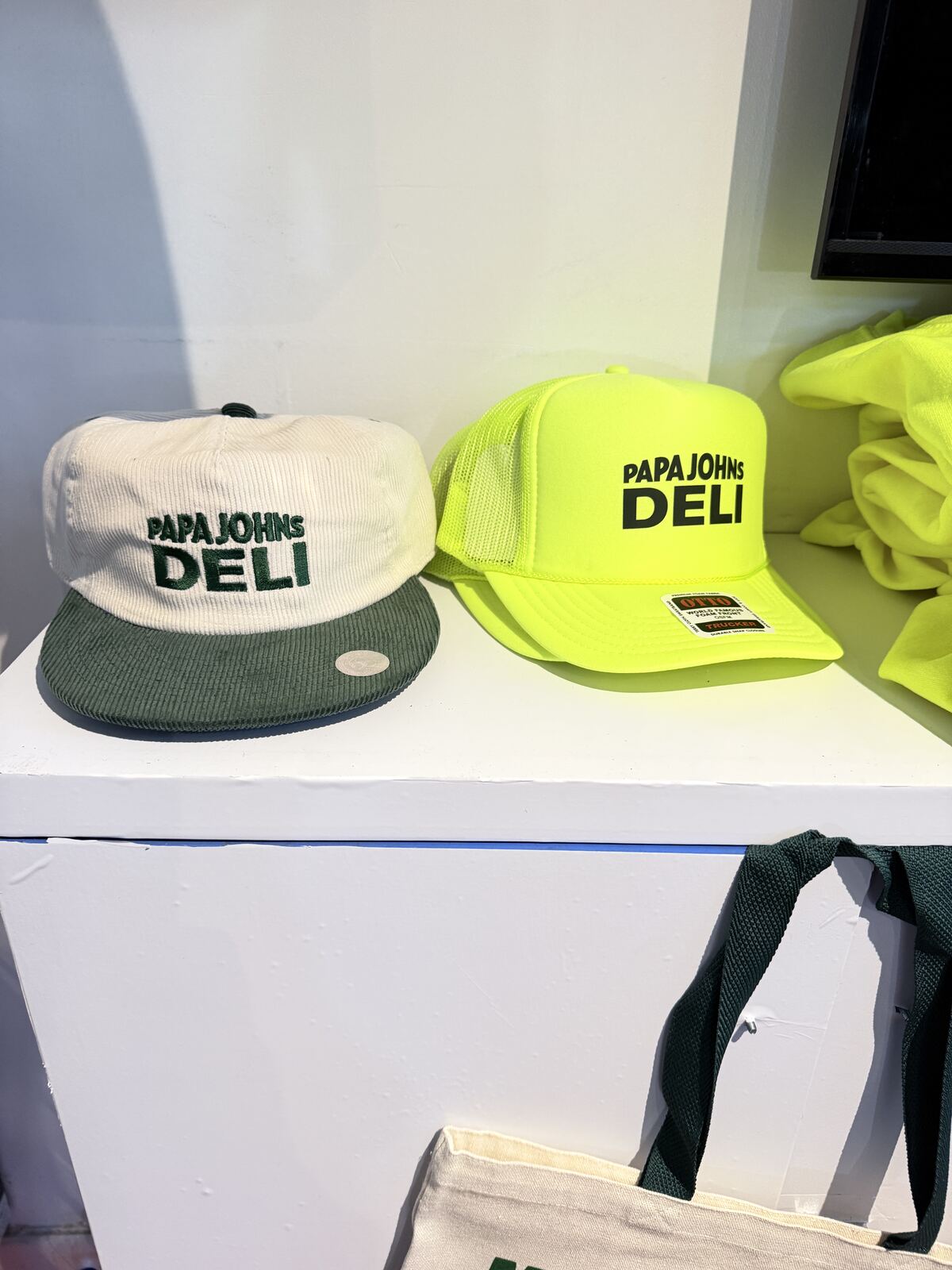
Ask a planner what a live customization station makes and they will say t-shirts. Shirts are the default, and they are a fine default. But the pieces guests actually keep — the ones that show up in photos two years later — are almost always hats and denim jackets, and they behave very differently at a live station than a flat cotton tee does.
This is a practical guide to running hats and jackets live: what decoration methods actually survive a curved crown or a heavyweight seam, what the throughput really looks like, and how to order blanks when the whole premise is that nobody tells you their size.
Why hats and jackets outperform shirts as keepsakes
Three reasons, in order of importance.
They do not need a size. A hat fits everyone. A denim jacket has three sizes that cover most of a room. That removes the single biggest source of friction and waste at a live station — the guest who wants a piece but you are out of mediums.
They are worn outward. A shirt gets folded into a drawer with forty other shirts. A hat lives on a hook by the door and gets grabbed. The perceived value is higher, so the piece survives the closet purge that kills event shirts.
They photograph. Guests put on a hat immediately, at the event, in the room you spent money decorating. A shirt goes in a bag. If part of the reason you are running a station is content, the difference is not subtle.
What actually works on a curved crown
A heat press is a flat tool, and a hat is not flat. The methods that hold up:
Chenille and embroidered patches are the most reliable, and the most tactile. Guests choose from a patch menu, we press or tack them to the front panel, and the result reads as intentional rather than printed-on. Patches also carry a varsity, collectible quality that guests respond to — people will take a second hat to get a second patch.
Cap-platen heat transfers use a curved lower platen designed for crowns. They handle full-color artwork that patches cannot, and they are faster per piece. The constraint is placement: transfers want the front panel and struggle across seams, so design accordingly rather than fighting it.
Live embroidery on a cap machine gives the highest-end finish and the longest per-piece time — think six to twelve minutes for a name or short word. It is a premium moment, not a volume method, and it works best as a VIP lane running alongside a faster station.
Airbrush on a structured cap is technically possible and practically a bad idea at an event: dry time, overspray, and inconsistent hold on coated or water-resistant crowns make it the wrong tool in a room full of people in nice clothes.
Denim: the highest-perceived-value blank at an event
A customized denim jacket is the piece guests will genuinely fight over, and it is the one blank where the material does most of the work for you. A few realities worth knowing before you order:
Back panels are the canvas. A large back hit — a patch cluster, a bold graphic, a name in script across the shoulders — is what makes the piece. Chest and sleeve marks are supporting details.
Heavyweight denim needs longer dwell and firm pressure. Transfers hold well on it, but the press settings are not the shirt settings, and seams and pockets need to be worked around. This is where an experienced operator earns their fee.
Patches are the natural language of denim. Guests already understand a patch-covered jacket. Give them a menu of eight to twelve patches and let them build a combination, and you get a piece that feels personal without you having to design anything bespoke.
Denim is expensive per unit, which changes the economics. Most events run it as a limited tier — the first fifty guests, VIPs, the wedding party, the executive team — with hats or shirts handling the rest of the room.
Throughput: what a station really produces per hour
Honest numbers, per station, with an experienced operator:
Patch-pressed hats run 30 to 45 per hour. Transfer-printed hats on a cap platen run 40 to 60. Live embroidery on caps runs 6 to 10. Denim jackets with a back graphic and one or two patches run 15 to 25, because the guest is making more decisions and the press cycle is longer.
The useful move is not to add presses until the math works — it is to shorten the decision. A guest choosing from six patches moves in under a minute. A guest choosing from thirty patches, four hat colors, and two placements will hold the line for four. Curate the menu ruthlessly and the same equipment produces nearly double.
Ordering blanks when nobody gives you a size
For hats, order by style, not size: a structured trucker, an unstructured dad cap, and one premium option in two or three colorways covers almost any room. Plan roughly 1.1 pieces per expected guest — some people take two, some take none, and it evens out closer than you would think.
For denim, a four-size run (S/M/L/XL) weighted toward M and L covers the majority. Unisex cuts simplify the wall enormously. If the jacket tier is capped, order the cap plus about ten percent and let the tier close honestly when it closes — scarcity is part of why the piece feels special.
Frequently asked questions
Can you customize hats and jackets guests bring themselves?
Sometimes, and it is worth asking early. Bring-your-own works well with patches on sturdy items and poorly with anything coated, waterproof, or heat-sensitive. We will not press a guest's own jacket without walking through the risk with them first — a scorched vintage Levi's is not a good moment.
How long before a guest can actually wear the piece?
Immediately. Pressed patches and transfers come off the platen warm and are wearable within a minute or two of cooling. This is the main practical advantage over airbrush or paint, which need real dry time before anyone puts them on.
Are these washable?
Yes. Properly pressed transfers and patches survive normal laundering — inside out, cold, tumble low is the standard care line. We include care instructions with the finished pieces so guests do not learn the hard way.
Plan the station
Send the event type, date, city, guest count, and which tier you picture — hats for the room, jackets for a smaller group, or both. We will come back with a station layout, realistic throughput for your window, and a blank order that does not leave you with four boxes of extra smalls.
Plan your live station
Ready to make it real?
Tell us your event and we’ll design the live station this post describes.